Budget and average cost per click for Google Ads
In most cases, the cost per click (CPC) will be significantly higher in Google Ads, than for ads on Facebook. The average cost per click in Bulgaria (Facebook) ranges between 0.06 leva and 1 leva, depending on the niche you operate in. While in Adwords we start at 0.10 stotinki and can reach 4-5 leva. So, if you have a very small monthly ad budget (for example 200-300 leva), it would be better to start with ads in Facebook, as this will allow you to reach a larger audience. I believe the number of clicks is not everything, and in some cases it is worth testing the performance of AdWords with smaller budgets, as you may attract visitors who already have an established intent to buy. Often, however, advertisers simply miss this fact and prefer to go straight for the cheaper channel.Your industry and your competition
The most important point to consider. What industry are you in? Where do your competitors advertise, how many are there, and how strong are they right now.Defining your goal
Once you determine what you can afford, what niche you are in, and what competition you have, you should then think about what you hope to achieve from this marketing initiative. If your goal is brand awareness, generating impressions or building lead lists, ads in Facebook will be your best choice. However, if you want to generate sales, then Google Ads is your trump card. On Google, the user is searching for what you may be selling. Therefore, intent and conversion rate are usually much higher.
Stages in the buyer's journey
Understanding what stage the user is currently at in the purchasing process will also help you decide which ad channel to use. If you want to catch users at the moment they want to buy a product or service, Google Ads is your best option. However, if you are trying to draw attention to your product or offer, then ads in Facebook can help you target those who have a current or still unknown need for your product or service. This is how the two channels can complement each other and fuel the growth of your business.Total search volume in Google Ads
This point is clear, but somewhat overlooked. If your organization offers a completely new product or service and there is very little or no search volume, Google Ads (paid search) will most likely not generate much traffic and therefore is unlikely to achieve the set goals. Before you rule out Google Ads in this scenario, you may want to consider bidding on a set of keywords that describe the problem your product or service solves. My recommendation is to highlight that, rather than the specific product or service that very few people know about. For example, Tile, described as a “Bluetooth tracker,” is one of the first of its kind. Keywords like “find your wallet,” “find your keys,” and “find your phone” could generate significantly more demand than “Bluetooth tracker” or even its own brand name. Demographically sensitive product or service Simply put, there may be cases where one advertising platform is more suitable than the other. If the purchase of your product or service strongly correlates with specific life events, then Facebook is most likely your best option. Facebook there are powerful targeting options, such as the ability to target based on life-changing events. For example, targeting those who are recently engaged or married, those who have turned 65 (medicare sales), or those who have recently had a new baby are examples of life events that can be targeted precisely through Facebook and not so easily through Google Ads. On the other hand, offering a product or service that appeals to broader audiences may be better advertised in Google Ads.Brand awareness
It is not as important as some other factors, but it is worth noting. If you are a new company, you will most likely be less successful in search than a mature, established company in your industry. Why? In this scenario, your competitors have much more brand awareness and loyal customers. They are established, and people know who they are and what they offer. When users see your ad (a company they do not recognize) and your competitor’s ad (one they do recognize), the likelihood of them choosing you is much lower. Larry Kim from WordStream wrote a great article about this concept of brand affinity as it relates to search, with many insights backed by data. So make sure you keep your company’s position in the market in mind. You may need to build your brand reputation through ads in Facebook, before launching a campaign in Google Ads, so that you increase your chances of success. This quick chart will help you make the best decision for you. Although there are exceptions to the rule, if your situation leans more toward one side or the other, that is the channel you should test first.
Conclusion
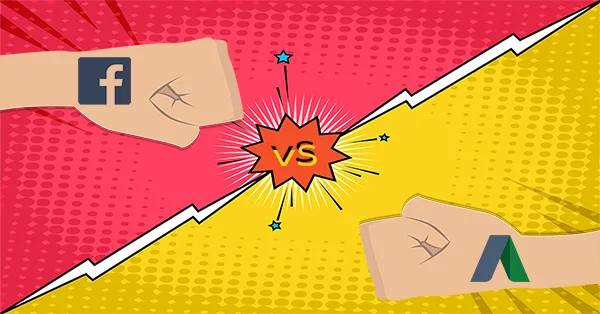
After reading these points, you will notice that there is no single, equal answer to when you should use Google Ads or Facebook. When trying to choose between the two channels, you should first take a step back and understand what you want to achieve, what industry you are in, where your competitors are, and what quality of visitors you are looking for. These are really the most important factors in making a choice. In short... there is no better channel. The two are fundamentally different and complement each otherIf you would like professional support creating Facebook or Google Ads campaigns, contact us at: 0888 530 444
Tell us in the comments which of the two channels you use and for what purpose?