Marketing decisions are difficult. Paid advertising, search engine optimization, social media, content marketing - all of these involve sending messages to an audience. The risk of social media marketing.. Depending on the channel, the marketer may not control the content, its distribution, or even the audience. In that case, a media channel classification model can help marketers think about communications in a more integrated way. One such model is PESO - paid, earned, shared, owned. By organizing tactics into paid, earned, shared, and owned media, you can better understand which channel creates more value, who owns the opportunities to promote content, and who controls distribution.
PESO vs PEO
Social media platforms are an important part of “shared” integrated marketing. However, some social-minded marketers disagree about the “shared” aspect, preferring three media distinctions instead of PESO’s four and grouping shared media platforms - for example Facebook, Twitter, Instagram, YouTube, TikTok - with the “owned” category. One could argue that reducing PESO to PEO still achieves the goal of helping people think about communications more strategically. It is a mistake to assume that every company owns the content in its social media. It is harmful if that means a company will focus on a channel that is outside its control.
Point of distinction
When marketers apply the PESO model, it is important to consider content, audience, and distribution. These three points distinguish media channels and help determine how content and advertising work together. As the table above shows, “your business creates” the content for social and shared media. In both cases, “your business” works to grow the audience, but your business does not control what the platforms do with the content, and despite growing followers, the business cannot take or easily transfer that audience to other channels. I once wrote: “Shared media uses content your business creates, distributed to an audience developed by your business through a platform owned or controlled by someone else.” This control is the key difference, and that is why social is not “owned” media.
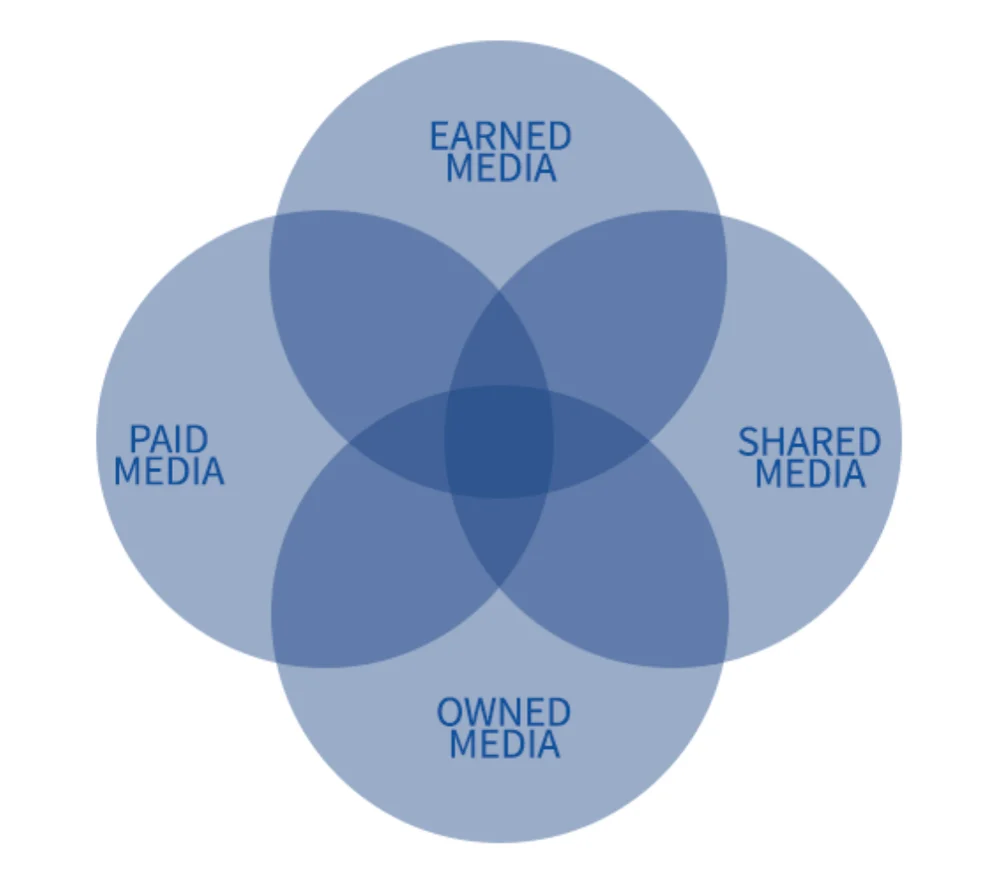
Diagram of four overlapping circles: earned media, shared media, owned media, and paid media.
Account suspension
As proof that companies do not own their social media channels, consider all the suspended accounts and the businesses that shut down because there were no alternative options. All social media platforms reserve the right to suspend, block, or remove accounts. The specific rules vary, but any business can publish lots of great content, build thousands of followers, and suddenly lose access to the account, the content, and the audience. This happens every day to small businesses.
Content removal
Platforms can remove individual posts. This is common on YouTube and Facebook, for example. When a YouTube creator produces critical content, the criticized party often files a copyright complaint, immediately stopping the criticism and forcing the creator into an arbitration process. The fact that YouTube and other platforms have content restrictions and often remove individual posts confirms that social media is not “owned” in the normal sense.
Creator economy
Creators and the so-called creator economy also show that “social” is not something businesses or individuals can “own.” Although creators can monetize their content on a given channel, they do not own their audience or the distribution of their content. For example, in 2019 many YouTube creators complained that the platform’s efforts to comply with the Children’s Online Privacy Protection Act had unfairly affected creators’ income. YouTube can limit advertising and therefore revenue sharing for any content it considers “not made for kids,” regardless of the creator’s intent. More recently, YouTube creators worried that Google would let its contract with
Roku expire, reducing views, ads, and revenue for many channels. Creators often encourage their audiences to sign up through email newsletters or communities to fight this problem. If they want to increase income, creators have to move beyond a specific platform. This is another example of why social media is never truly “owned.”
My Space
The final reason against classifying social platforms as owned is that their popularity can decline. MySpace and the now-defunct Friendster were competitors to Facebook, but they no longer exist. Nothing guarantees that Facebook, Instagram, or any other social network will survive the next five or ten years. Some legislators and Web3 advocates are seeking to split up and replace these platforms.
Not owned
When companies start to think they own their social media content and audience in the same way they own a blog or an email list, they risk losing control over content and customer relationships. The PESO model is designed to help marketers think about communications in an integrated way and use all four channels appropriately. Social media is certainly an important part of the mix, but in the end your company content should be solid assets you own. Customer relationships should be direct, not through proxies like Facebook or TikTok. If you need to develop your marketing strategy and apply this approach,
contact us.
RELATED TOPICS:
Unexpected marketing trends in 2026
RELATED TOPICS:
Facebook Ads: Pros and Cons
 Diagram of four overlapping circles: earned media, shared media, owned media, and paid media.