
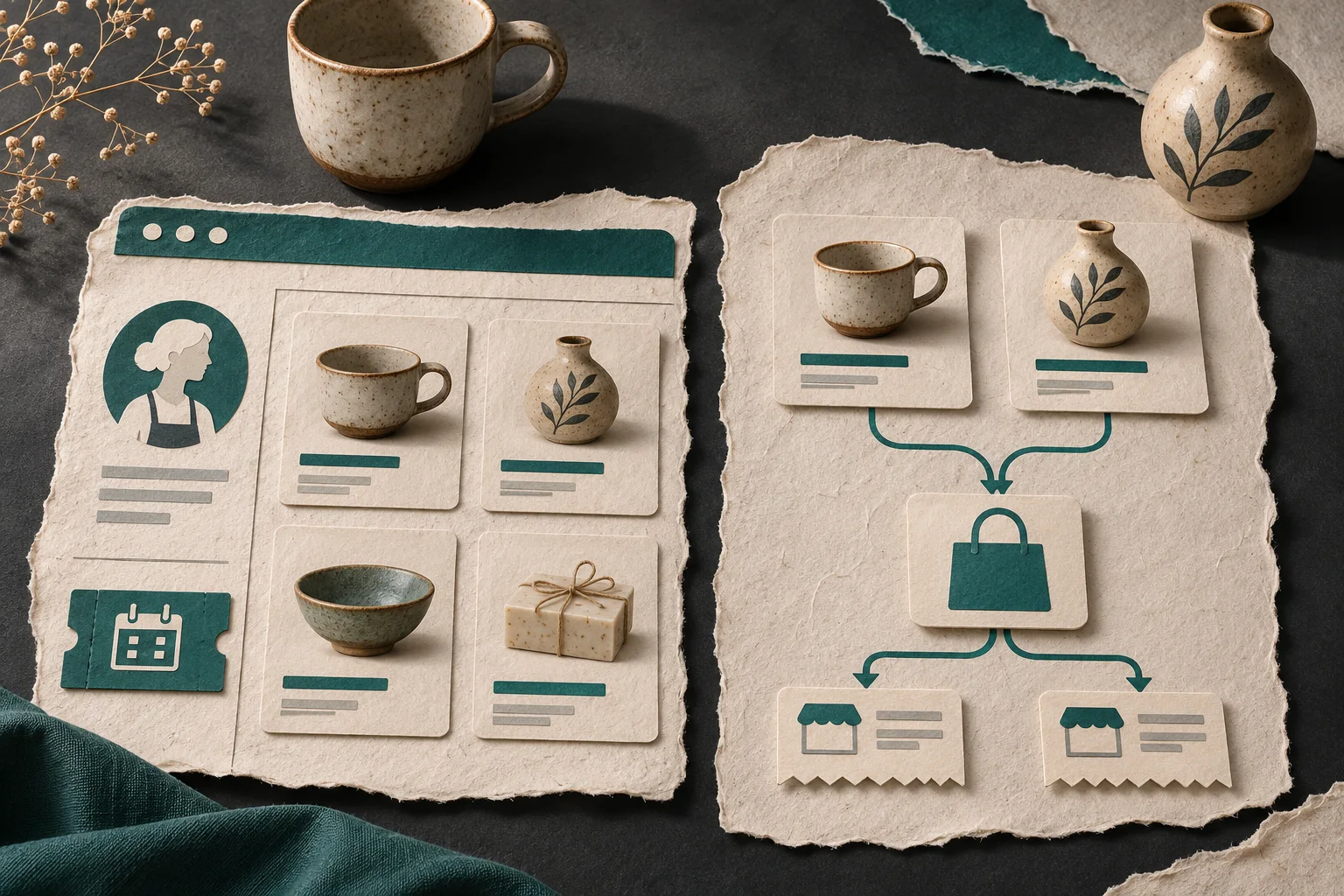
An artisan sells a handmade cup for 60 euros. The buyer found it through your platform. What does the artisan owe you money for? The space where they displayed the cup? The fact that their listing reached more people? Or the order they’ve already received?
The answer also affects the cost of building the platform. With paid listings, you need to know who posted what, for how long, and with which rights. With a sales commission, you also need to know what was ordered, who fulfilled it, how much the seller is owed, and what happens if the buyer returns the cup.
For “Ръцете Български,” we chose the classifieds platform model. We wanted less administrative work and a direct benefit for the person who makes the item. But if I needed to attract many independent merchants, each with a large catalog, my recommendation would be simple. Upload your products. When we bring you a sale, you pay us a commission. Here’s how I’d decide which of the two models is worth building.
The Racete.bg example comes from 88Lab’s experience: we explain the choice we made while developing our own project.
Which model is right for your platform?
Paid listings and packages work well when the platform provides visibility and contact, while the purchase is arranged directly with the seller. A commission model works well when you can track the order, fulfillment, and the amount on which you charge a fee. When choosing, compare the value for sellers, service costs, and technical complexity.
On a phone, swipe the table horizontally to see all columns.
| Criterion | Paid listings / packages | Sales commission |
|---|---|---|
| What the seller pays for | Publishing, listing capacity, or extra visibility | An agreed share of the completed sale |
| Where the purchase is arranged | It can be arranged directly with the artisan or merchant | The platform must reliably track the sale |
| Best suited to | One-of-a-kind items and orders that require a conversation | Catalogs of standard items and trackable orders |
| Main technical task | Limits, durations, moderation, and activation of paid features | Orders, commissions, payments, returns, and seller reports |
| What the operator measures | Inquiries and paid package renewals | Completed sales and revenue after service costs |
Why we chose paid packages for “Ръцете Български”
Someone finds a ceramic artisan, likes one of their cups, and asks if they can get six in the same color by the end of the month. Only the artisan knows what’s ready, when they’ll fire the kiln, and whether they’d accept the order. A conversation can be more useful to both sides than a button for instant payment.
That’s the idea behind our platform for handmade products. Visitors browse an item, see who made it, and can contact the artisan. The two parties arrange the purchase, payment, and delivery directly. We provide the place where they can find each other. For the artisan, this means having their own profile and control over the agreement. For our team, it means we don’t have to distribute the money from every item sold.
So what does the artisan buy from the platform? As of November 17, 2026, they can start for free with two active listings at a time. If they want to showcase a larger collection, the “Studio” package costs 6.99 euros for 30 days and allows up to 15 active listings. You can promote one listing separately for €4.99. The promotion lasts up to 30 days, within the listing’s remaining validity period. Renewal is manual. Racete.bg package terms
These simple terms require a few precise decisions during development. Imagine a creator has published one listing using the free package and submitted a second for approval. It already takes up the second slot, even though buyers can’t see it yet. A draft doesn’t take up a slot. When an active listing is hidden or expires, its slot becomes available. If the profile only says “You’ve reached the limit,” the person has reason to ask where their second listing is. You can plan an explanation from the outset, such as “One published, one awaiting approval.”
What happens after payment is a separate consideration. At Racete.bg, Stripe processes package purchases and promotions. The entitlement is activated once the system receives confirmation. Receiving confirmation again for the same payment must not add a second package. This is part of the work even when the platform itself doesn’t receive payment for the products. How we developed Racete.bg
When I’d choose a commission-based marketplace
Imagine a different conversation. You invite a seller with 3,000 products to join a new platform. They already run their own store and need to set aside time to provide you with descriptions, photos, and stock levels. If you also charge a fee for each listing, their first reasonable question is how many orders you can bring them. At the beginning, you probably don’t yet have a convincing answer.
For a catalog like this, I’d offer free listings and a commission on completed sales. The seller knows in advance what share they’ll give up and can work out which products are profitable for them. They incur a commission cost only after making a sale. The operator has a clear incentive to attract buyers, improve search, and fix the reasons orders fall through. Their revenue depends on it too.
A familiar example in the Bulgarian market is eMAG Marketplace. According to its published terms, sellers can list products without a listing fee. When a sale is made, the platform charges a commission based on the product category. For my own project, I’d start by looking at sellers’ margins before setting the percentage. On an item worth €60, a €6 commission might be acceptable to one seller and consume nearly all the amount another has left after the cost of goods and order expenses. Seller terms on eMAG Marketplace
The number of products is only part of the decision. You could bring together thousands of unique items whose size, timeline, and final price are agreed on personally. Or you could have a small catalog of standard goods ready to ship today. In the second case, the platform can more easily track the order from selection through fulfillment. In the first, you need to answer an awkward question: how will you know a sale has been made, and what amount will you calculate the commission on? If you lose that information after the inquiry, you’re building a future dispute with the seller into the project from the outset.
How the model changes the development brief
A big difference between two development quotes can be hidden in the phrase “shared shopping cart.” Imagine a €100 order containing a €60 cup from one seller and a €40 jug from another. The first ships the cup right away. The second finds that the jug is damaged and cancels their part. What does the buyer see? What amount is the commission calculated on? Which payment can be paid out to the first seller while the issue with the second is still being handled?
If it’s enough for customers to order from one seller at a time at launch, say so when requesting a quote. If a shared cart is why customers come to you, build separate seller-level statuses and an accurate link between the amount paid, refunded, and owed into the first version. Payment services such as Stripe Connect allow a single payment to be split across multiple accounts. You decide how this appears in the order and in each seller’s report. Stripe documentation on splitting payments
Splitting the payment doesn’t automatically resolve refunds. With Stripe’s separate charges and transfers model, refunding the payment doesn’t automatically reverse transfers that have already been made. The brief needs to set out who covers the amount and when a reverse transfer is made. Stripe: refunds with separate charges and transfers.
Cash on delivery adds another dimension to the question. A parcel may have been shipped but remain unclaimed. Specify how you know the buyer has received it, who confirms this, and when the commission appears in the report. If the seller manually marks receipt in the first version, specify who can correct an error and how it will affect a report that has already been prepared.
At what sales volume does the package become cheaper?
Let’s compare two hypothetical offers for the same period. The first costs €30 for a package that accommodates the seller’s entire catalog. The second has free listings and a 10% commission. To compare fees alone, we’ll assume the same completed sales through both platforms, with no returns. These are example figures.
For €120 in sales the seller would pay €12 in commission or €30 for the package. At €300 the two fees are equal. At €900 the commission is now €90, while the package remains €30. You can do the calculation for your own idea by dividing the package price by the commission rate expressed as a decimal. In this example: 30 ÷ 0.10 = €300 in sales for the period.
| Completed sales | Package fee | 10% commission |
|---|---|---|
| 120 € | 30 € | 12 € |
| 300 € | 30 € | 30 € |
| 900 € | 30 € | 90 € |
This is a hypothetical example, not a price offer. It compares only the platform fee at the same sales volume and with no returns. It doesn’t include other sales costs.
The seller wants to know something else, though: how many sales does each channel bring them? If the package-based platform brings two orders while the commission-based one brings twenty, comparing fees alone would be misleading. For every additional order, they need to see what remains after the cost of the product, packaging, their share of delivery, and the commission. A ceramics seller should also include their own labor in this calculation.
The operator does a separate calculation. On a €60 order with a 10% commission, they earn €6 in revenue before expenses. If acquiring the order cost €4, that leaves €2 for processing, support and other costs. Packages are a different matter. What did the merchant get during those 30 days that would make them pay again? Track whether listings receive inquiries and how many sellers renew after the first paid period. For purchases arranged directly, the number of inquiries and the number of completed sales are different metrics.
How to make the decision before the first offer
Take an actual product from a prospective seller. Map out a successful order from listing to the point when everyone has received their money. Then run through the same scenario with one complication. For example, the product is out of stock, the buyer returns part of the order, or the paid listing expires on the day of the inquiry. For each step, note who acts, what they see in their account, and what the administrator needs to be able to verify.
Show your description to two prospective merchants. Ask whether they would upload their catalog under these terms, who will manage inventory, and how they will check what they have been charged for. If you offer a package, ask what value they expect to get before renewal. If you charge a commission, choose three of their products with different margins and calculate together what they would be left with after a sale.
With these answers, you can request comparable quotes for online platform development. One provider may include only listings and contact, while another may also account for processing orders from multiple sellers. When both have to show how the system handles the same €60 purchase, you’ll quickly understand exactly what they’re offering and what’s worth paying for.
The terms of Racete.bg and the external sources cited were checked on November 17, 2026. Prices and terms may change.